
The Creative Multiverse Is Real.
Theres more than one idea. But not for the reasons you think.

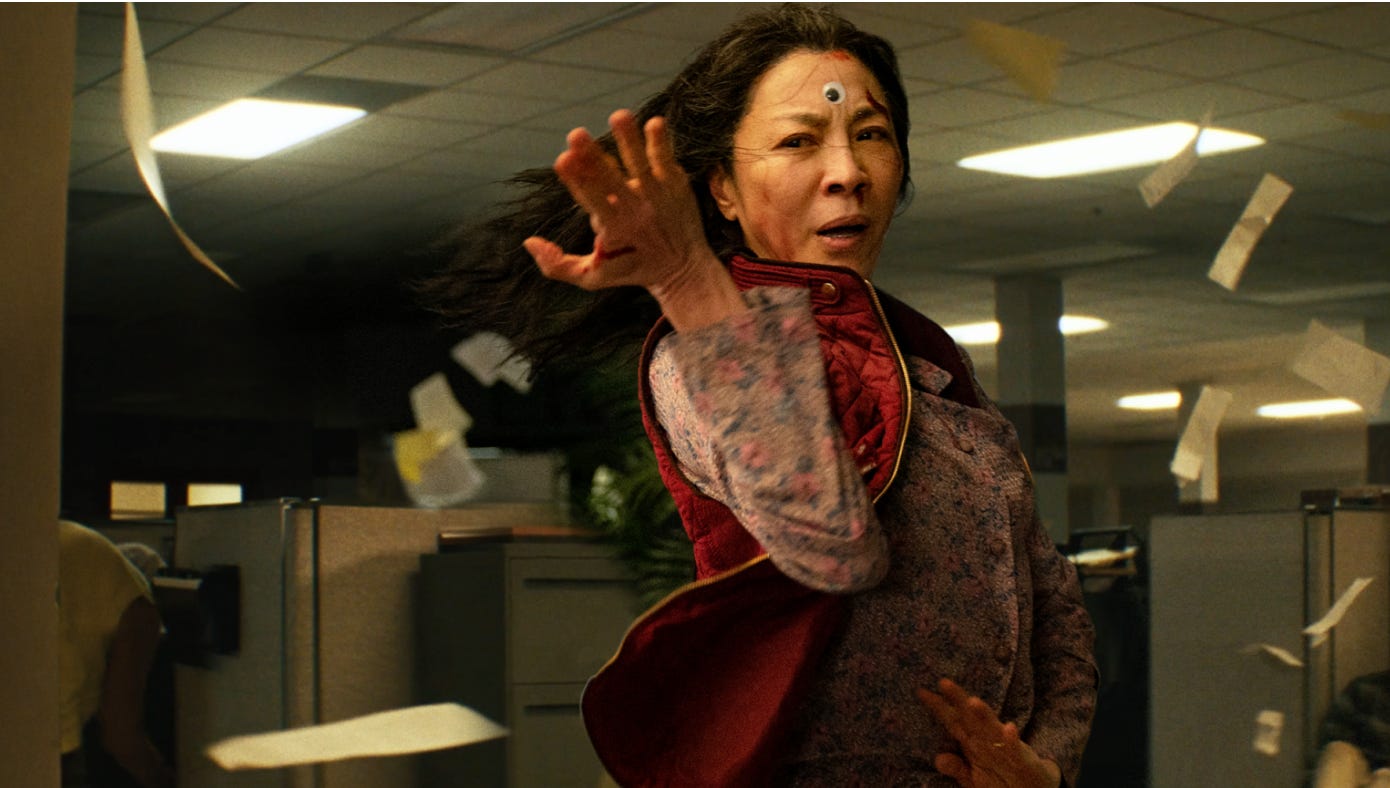
The quantum world is still very mysterious, still seemingly very powerful, and I’m definitely attracted to the mysterious and the unknown and just the vastness of what my imagination puts on it.
—Van Hunt
A friend recently told me his therapist said he had a problem with commitment. This was rich, he said, coming from a woman who still hadn’t decided what to do with the throw pillows on her waiting room couch. Floral or solid. Solid or floral. Apparently the poor thing had been struggling with this for years.
But in a way, she had a point.
Myself, I can spend three weeks deciding whether an essay should be funny or sad, personal or observational, the kind of piece that wins awards or the kind that gets read. Most people call this being undecisive. Physicists, bless them, call it superposition.
Now, if you’re anything like me, what you understand about quantum physics barely fits into an acorn shell. My high school physics teacher, Mr. Lafferty, once tried to discourage me from becoming an astronaut. Astronauts deal a lot with physics. That did it. Count me out.
Anyway.
Superposition, as it was eventually explained to me, is the idea that a particle exists in all of its possible states at once, until someone looks at it. Before anyone looks, it is everything. It is doing everything. It is a particle having the time of its life.
I find this almost unbearably comforting, because it means that for one brief, shimmering moment, before I commit to a single version, every idea I have is a good one. Possibly a great one. A masterpiece, even. No one has looked yet, and so no one can prove otherwise.
The problem, and there is always a problem, is that human beings are incapable of leaving anything alone. Someone asks what you’re working on, and the novel about your dead mother becomes “a sort of dark comedy, but also a meditation on loss, and honestly it’s hard to explain.” The moment the words leave your mouth, that is what it is. You have looked at it. Worse, you have made other people look at it. The particle has collapsed, and your mother is now a dark comedy.
Writers do this. Painters do this. Advertising people do it the way other people breathe. I once stood at an awards ceremony and watched an art director describe her new campaign four separate times to four separate people, each version a little more confident and a little less true than the one before, until by the end of the evening she had talked herself into something that not one of us believed, including, visibly, her. She left looking like a woman who had agreed to marry someone at a party and was only now remembering she’d done it.
The physicists call this collapse, and to them it’s nothing. A neutral event. The universe making up its mind and moving on. In creative work it feels more like a funeral, small and poorly attended and entirely unnecessary, the deceased having been perfectly healthy right up until the moment someone asked it to define itself.
The thing is, nobody tells you that it’s okay to be undecided for a while. There is, instead, an enormous and unrelenting pressure to have decided, to walk into the room with a vision, to be the sort of person who is certain. I have never once been that person.
I have, however, spent a great deal of energy impersonating him. I am an accomplished nodder. I have sat in meetings and said, with real gravity, “the throughline here is really about belonging,” while privately thinking, “I have no freaking clue what I’m talking about and that I would very much like to lie down on the conference table and be left there.
A college writing teacher once told me that my inability to commit to a direction was fear-based. I found this so insightful that I wrote it down, and then I did not look at what I had written for two years, which I think we can all agree settles the question of whether he was right.
But here is what he didn’t tell me, what none of them told me.
All of that stalling, all of that refusing to choose, all of those weeks spent letting a thing remain everything it could possibly be, is not the character flaw I’ve been raised to think it is. It is, as it turns out, the only reliable way I’ve ever found of arriving at the best version of the thing I’d meant to make in the first place.